Intermittent Fasting Schedules: 16:8, 18:6, 20:4 and 5:2
An intermittent fasting schedule splits your day (or week) into hours when you eat and hours when you don’t. The most popular is 16:8: fast for 16 hours, eat within 8, for example 12pm to 8pm. Others run from a gentle 12:12 to one meal a day, or the 5:2, where you eat normally five days a week and very little on two.
Here’s how each schedule works, example times that fit a normal working day, which one to start with, and what the research actually says about fasting for weight loss and muscle.
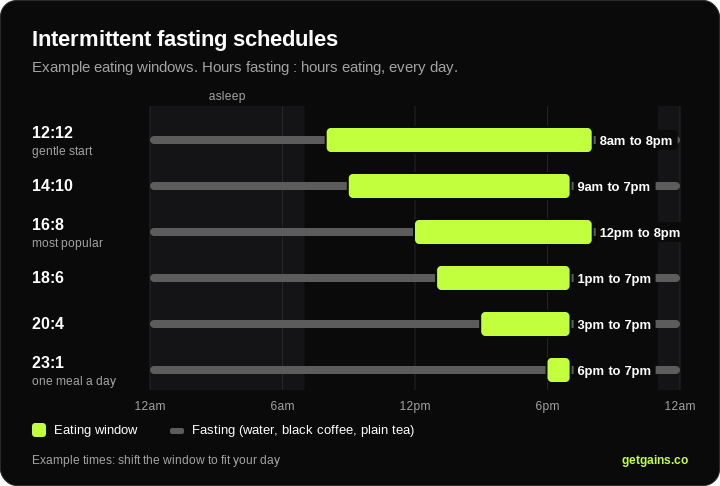
Intermittent fasting schedules at a glance
The numbers are always hours fasting : hours eating. Sleep counts towards the fast, which is why most schedules feel shorter than they sound.
| Schedule | Fast | Eat | Example eating window | Good for |
|---|---|---|---|---|
| 12:12 | 12 h | 12 h | 8am to 8pm | A first step: often just “no late-night snacks” |
| 14:10 | 14 h | 10 h | 9am to 7pm | Easing in; still room for three meals |
| 16:8 | 16 h | 8 h | 12pm to 8pm | The most popular; skip breakfast, eat lunch and dinner |
| 18:6 | 18 h | 6 h | 1pm to 7pm | People already comfortable on 16:8 |
| 20:4 | 20 h | 4 h | 3pm to 7pm | Two smaller meals close together, or one big one |
| 23:1 (OMAD) | 23 h | 1 h | 6pm to 7pm | One meal a day; hard to fit enough protein in |
| 5:2 | 2 days a week | 5 days | Normal eating Mon to Fri except two low days | People who’d rather have two hard days than a daily rule |
Think of the eating window as a shop’s opening hours. The shop sells the same stock whether it’s open 8 hours or 12; it’s just busier when the hours are shorter. Your calories work the same way.
16:8 fasting: the one most people start with
On 16:8 you fast for 16 hours and eat within an 8-hour window. The classic version skips breakfast:
- 12pm to 8pm: lunch at 12, a snack mid-afternoon, dinner by 8. Fits most office days and evening plans.
- 10am to 6pm: a late breakfast and an early dinner. Suits early risers and people who don’t eat late.
- 8am to 4pm: breakfast and lunch, a light early tea. Works if you go to bed early, but it’s hard with family dinners.
If you train in the evening, the 12pm to 8pm window lets you eat after your session. If you train first thing, a 10am start gets food in soon after.
18:6, 20:4 and one meal a day
These are the same idea with a shorter window.
- 18:6 (for example 1pm to 7pm) leaves room for two meals and a snack.
- 20:4 (3pm to 7pm) usually means one big meal and one smaller one.
- 23:1, or OMAD (one meal a day) packs everything into about an hour.
The shorter the window, the harder it is to eat enough protein, fruit and veg, and to fuel training. If you lift, that matters (see below). Longer fasts aren’t magic: they work through the same calorie maths as the gentler ones.
The 5:2 diet
The 5:2 works by the week, not the day. You eat normally on five days and much less on two non-consecutive days, often around a quarter of your usual intake. In one well-known UK trial of overweight women, two days a week at about 650 kcal lost about as much weight over six months as cutting calories every day (6.4 kg vs 5.6 kg, not a meaningful difference) (Harvie et al., 2011).
Does intermittent fasting work for weight loss?
Yes, but not because of the clock. It works when it helps you eat fewer calories, and the research suggests it isn’t better than cutting calories in other ways:
- 16:8 on its own: in a 12-week trial, people eating only between 12pm and 8pm lost about the same as people eating three normal meals: no meaningful difference between the groups (Lowe et al., 2020).
- Fasting plus the same calorie target: over 12 months, people on the same calorie limit lost similar weight whether they ate only between 8am and 4pm or ate across the day (8.0 kg vs 6.3 kg, not a significant difference) (Liu et al., 2022).
- 5:2-style fasting vs daily dieting: a review of 11 trials found similar weight loss either way (Cioffi et al., 2018).
So fasting is a way of creating a calorie deficit, not a shortcut around one. If skipping breakfast makes eating less easier for you, it’s a good tool. If it makes you ravenous and you overeat at night, it isn’t. Use the calorie deficit calculator to find your daily target, then fit it into whatever window you choose.
Intermittent fasting and building muscle
You can keep your muscle on 16:8 if you eat enough and keep lifting. In a study of resistance-trained men, eating all their calories in an 8-hour window for 8 weeks cut some fat while muscle and strength held steady, compared with the same calories spread over the day (Moro et al., 2016). The TREAT trial above, which had no training, saw a small drop in lean mass in the fasting group, which is one more reason to keep lifting.
Three things help:
- Hit your protein. Use the protein calculator for your daily number.
- Spread it out. A review suggests about 0.4 g of protein per kg per meal across at least four meals for the most muscle-building (Schoenfeld and Aragon, 2018). Four meals fit in an 8-hour window; they don’t fit in one hour, which is the problem with OMAD for lifters.
- Eat around your training. If you can, put your session inside your eating window or just before it opens.
What can you have while fasting?
Most plans allow drinks with no or almost no calories: water, sparkling water, black coffee and plain tea. Milk in your coffee, juice, smoothies and protein shakes all break the fast. Diet drinks are a grey area; plenty of people use them to get through the last hour.
Who shouldn’t try intermittent fasting
Fasting isn’t for everyone. Don’t try it if you’re pregnant or breastfeeding, or if you’ve had an eating disorder. If you have diabetes, especially if you take insulin or tablets such as sulphonylureas, fasting can raise the risk of hypos, so speak to your diabetes team first (Know Diabetes). The same goes for anyone under 18, anyone on medicine that has to be taken with food, and anyone with a long-term health condition: check with your GP.
Stop and get advice if you feel dizzy or faint, or if fasting starts to make you anxious about food. If you’re worried about your eating, Beat, the UK eating disorder charity, can help: call 0808 801 0677 or visit beateatingdisorders.org.uk.
How to start intermittent fasting
- Start at 12:12. Stop eating after dinner and have breakfast 12 hours later. Most people already nearly do this.
- Move up an hour every few days. 13, then 14, then 16 hours. Push breakfast later rather than dinner earlier, as it’s usually easier.
- Keep the window the same each day. Your hunger settles into a routine, a bit like jet lag wearing off.
- Eat proper meals in the window. Protein, veg and slow carbs, not just whatever’s quickest.
- Judge it after 3 to 4 weeks. Is your weight trend going the right way? Are your lifts holding? Do you actually like it? If not, a normal meal pattern works just as well.
Common questions
What is the best intermittent fasting schedule for beginners?
Start with 12:12 or 14:10 and move to 16:8 if it feels easy. 16:8 is the most popular because skipping breakfast is all it takes for many people.
How many hours should I fast?
For most people 12 to 16 hours a day is plenty. Longer fasts haven’t been shown to lose more weight when calories are the same, and they’re harder to stick to.
Does sleep count as fasting?
Yes. Every hour you sleep counts. On 16:8 with eight hours’ sleep, you’re only fasting for eight waking hours.
Can I work out while fasting?
Yes. Plenty of people train before their eating window opens. If heavy sessions feel flat, move your training to later in your window or have your first meal before it.
Does intermittent fasting slow your metabolism?
In the study of trained men on 16:8, resting energy expenditure didn’t change over 8 weeks (Moro et al., 2016). Like any diet, losing weight lowers how much you burn a little, because a smaller body uses less energy.
Track your fasts in Get Gains
Get Gains has a free fasting timer built into the food diary. Start a fast with one tap, pick a 13, 16, 18, 20 or 24-hour goal, change the start time if you forgot to press it, and see your streak of completed fasts. Log food while a fast is running and it asks whether you want to end it. Your calories, macros and workouts sit in the same app, so you can see whether your eating window is actually helping.
Sources
- Lowe DA et al. (2020). Effects of time-restricted eating on weight loss and other metabolic parameters in women and men with overweight and obesity: the TREAT randomized clinical trial. JAMA Intern Med 180(11):1491-1499
- Liu D et al. (2022). Calorie restriction with or without time-restricted eating in weight loss. N Engl J Med 386(16):1495-1504
- Cioffi I et al. (2018). Intermittent versus continuous energy restriction on weight loss and cardiometabolic outcomes: a systematic review and meta-analysis of randomized controlled trials. J Transl Med 16:371
- Harvie MN et al. (2011). The effects of intermittent or continuous energy restriction on weight loss and metabolic disease risk markers: a randomized trial in young overweight women. Int J Obes 35(5):714-727
- Moro T et al. (2016). Effects of eight weeks of time-restricted feeding (16/8) on basal metabolism, maximal strength, body composition, inflammation, and cardiovascular risk factors in resistance-trained males. J Transl Med 14:290
- Schoenfeld BJ, Aragon AA (2018). How much protein can the body use in a single meal for muscle-building? Implications for daily protein distribution. J Int Soc Sports Nutr 15:10
- Know Diabetes: Intermittent fasting
- Beat: the UK's eating disorder charity