Creatine for Women: Benefits, Dose and Menopause
Yes, creatine works for women. The standard dose is the same as for men, 3–5 g of creatine monohydrate a day, and it works best alongside strength training. The evidence for strength and performance is reasonable; for muscle size in women it’s mixed; and for bone after the menopause, the biggest trial so far found no change in bone density.
Most creatine research has been done in young men, so the honest answer for women is “promising, with gaps”. This guide sticks to what the studies actually found. It’s the difference between a product’s advert and its small print: we’ve read the small print.
Does creatine work for women?
Creatine helps women lift a bit more and train a bit harder, according to the research so far. A 2021 review of creatine in women’s health (Smith-Ryan et al.) concluded that before the menopause, creatine “appears to be effective for improving strength and exercise performance”. It also noted that women are understudied compared with men.
How it works is the same for everyone. Creatine tops up your muscles’ stores of phosphocreatine, which they use to rebuild energy during short, hard efforts like a heavy set. It’s a slightly bigger fuel tank for the last few reps: it won’t change the engine, but it can get you a little further each set. For the full mechanism, see what does creatine do?
Creatine and muscle in women: the mixed part
Here’s where the evidence is less clear. A 2022 meta-analysis of 35 trials (Delpino et al.) found creatine plus resistance training increased lean body mass overall. But when it split the results by sex:
| Group | Extra lean mass with creatine vs placebo |
|---|---|
| Men | 1.46 kg (statistically significant) |
| Women | 0.29 kg (not statistically significant) |
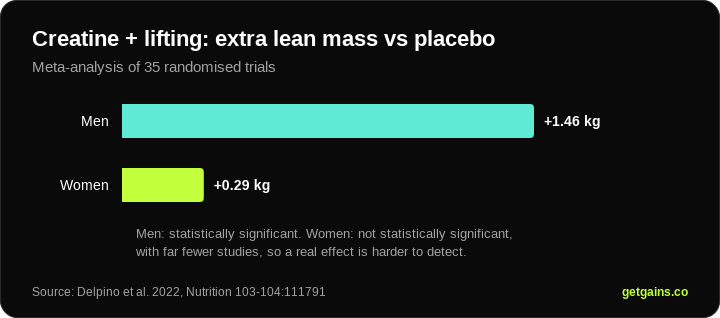
That doesn’t mean creatine does nothing for women’s muscles. There were far fewer studies in women, which makes a real effect harder to detect. It does mean you shouldn’t expect dramatic changes in muscle size from creatine alone. The training does the building; creatine is a helpful extra on the site, not the builder.
Creatine for women over 40 and during the menopause
Interest in creatine for the menopause has grown fast, mainly for muscle and bone. The evidence is still catching up with the headlines.
Bone: the largest and longest trial so far, Chilibeck et al. (2023), gave 237 postmenopausal women (average age 59) creatine or placebo for two years alongside resistance training and walking. Creatine had no effect on bone mineral density at the hip or spine. It did help maintain some measures of bone shape at the top of the thigh bone that predict bending strength.
Strength and muscle in the same trial: creatine didn’t improve one-rep max on bench press or hack squat compared with placebo. Women who completed the study did gain a little more lean tissue on creatine (2.3 kg vs 1.6 kg), and they walked slightly faster.
What that adds up to: creatine is not a substitute for HRT, calcium, vitamin D or strength training for bone health. If you’re already lifting, it may add a little, and it appears safe. If you’re thinking about it mainly for your bones, talk to your GP about the treatments with stronger evidence first.
Brain and mood: the 2021 review describes early research on creatine, mood and cognition in women. It’s an interesting area, but too early to recommend creatine for it.
Hot flushes and other menopause symptoms: we found no good evidence that creatine helps with these.
How much creatine should a woman take?
The dose is the same as for men: 3–5 g of creatine monohydrate a day, every day, according to the ISSN position stand. There’s no women’s version of creatine; “creatine for women” products are the same molecule in different packaging. Pink razors, but for supplements.
- Loading is optional. A week at about 0.3 g per kg of body weight a day fills your muscles faster, but 3–5 g a day gets you to the same place in about four weeks.
- Monohydrate is the form to buy. It’s the most studied and usually the cheapest.
- Timing doesn’t matter much. Taking it every day does.
Our creatine calculator works out your daily dose and an optional loading plan from your weight.
Will creatine make me gain weight or look bloated?
You may gain a little weight at first, and it’s mostly water inside your muscles, not fat. The 2021 ISSN review notes that a loading phase typically adds 1–3 kg (2–7 lb), and that the change is usually smaller and slower without loading.
If the scales matter to you, skip loading and start at 3 g a day, and weigh yourself as a weekly average rather than day to day. Read more in does creatine make you gain weight?
Is creatine safe for women?
At recommended doses, creatine appears safe for healthy adults, women included. The ISSN reports studies of up to 30 g a day for five years without harm in healthy people.
Speak to your GP, midwife or pharmacist before taking creatine if you:
- are pregnant, trying to get pregnant or breastfeeding: there isn’t enough research in pregnancy to say it’s safe;
- have kidney disease or take medication that affects your kidneys;
- are under 18;
- are having a kidney blood test: creatine can raise creatinine, the marker doctors use, without your kidneys being harmed, so tell your doctor you take it.
This guide is general information, not medical advice (see our terms).
Making creatine work: the practical bit
Creatine works if you take it every day and lift weights. Missing it for a week is like skipping charging your phone: nothing breaks, but the battery runs down.
- Take 3–5 g of creatine monohydrate daily, with whatever meal you’re most likely to remember.
- Strength train two or three times a week. That’s where the benefit shows up. Our beginner workout plan is a good place to start.
- Eat enough protein. The protein calculator gives your target.
- Give it at least four weeks before you judge it.
The Get Gains app has supplement tracking with reminders on the free plan: add creatine to your stack, get a daily nudge, and tick it off straight from the notification. Because your workouts, PBs and body weight live in the same app, you can see whether your lifts actually move in the weeks after you start, rather than relying on how you feel.
Creatine for women: quick answers
- Does it work? For strength and performance, the evidence is reasonable. For muscle size, results in women are mixed.
- How much? 3–5 g of creatine monohydrate a day, the same as men.
- Does it help bones after the menopause? A two-year trial found no change in bone density, though some bone-shape measures were better maintained.
- Will it make me bulky? No. Any early weight gain is mostly water in the muscle.
- Is it safe? For healthy adults at normal doses, it appears so. Check with your GP or midwife first if you’re pregnant, breastfeeding or have kidney problems.
How we wrote this: drafted with AI assistance, then fact-checked against the sources below and edited by Alex Lawrence. Read our editorial policy.
Sources
- Smith-Ryan AE, Cabre HE, Eckerson JM, Candow DG (2021). Creatine supplementation in women's health: a lifespan perspective. Nutrients 13(3):877
- Delpino FM et al. (2022). Influence of age, sex, and type of exercise on the efficacy of creatine supplementation on lean body mass: a systematic review and meta-analysis of randomized clinical trials. Nutrition 103-104:111791
- Chilibeck PD et al. (2023). A 2-yr randomized controlled trial on creatine supplementation during exercise for postmenopausal bone health. Med Sci Sports Exerc 55(10):1750-1760
- Kreider RB et al. (2017). International Society of Sports Nutrition position stand: safety and efficacy of creatine supplementation in exercise, sport, and medicine. J Int Soc Sports Nutr 14:18
- Antonio J et al. (2021). Common questions and misconceptions about creatine supplementation: what does the scientific evidence really show? J Int Soc Sports Nutr 18:13