Progressive Overload Explained: 5 Ways, With Examples
Progressive overload means making your training a little harder over time, so your body keeps having a reason to get stronger. The simplest way: pick a rep range (say 8–12), add reps each session until you hit the top of the range on every set, then add a small amount of weight and start again at the bottom.
Your muscles adapt to what you ask of them, then stop. Lift the same 20 kg (45 lb) dumbbells for the same 10 reps every week and, after a few weeks, your body has no new problem to solve. It’s like a commute you’ve done a hundred times: after a while you stop noticing the hill.
What is progressive overload?
Progressive overload is the principle of gradually increasing the demand on your muscles. The American College of Sports Medicine’s position stand on resistance training lists it as one of the core principles of any programme that keeps producing results.
The key word is gradually. You’re not trying to set a personal best every session; you’re trying to be slightly better than last time, over and over. Think of it as a savings account: small regular deposits beat one heroic lump sum followed by nothing.
5 ways to apply progressive overload
Adding weight is the obvious one, but it’s only one of five levers.
| Lever | Example | Best for |
|---|---|---|
| 1. More weight | Squat 60 kg × 8 → 62.5 kg × 8 (132 lb → 138 lb) | Big compound lifts |
| 2. More reps | Bench 50 kg × 8 → 50 kg × 10 | Dumbbell and machine work, where jumps are big |
| 3. More sets | 3 sets → 4 sets of the same exercise | Adding volume for a lagging muscle |
| 4. More effort | Finishing sets closer to failure (e.g. 3 reps left in the tank → 1) | Experienced lifters |
| 5. Better technique or range | Half squat → full-depth squat; push-ups on a bench → on the floor | Beginners and bodyweight training |
More reps counts just as much as more weight. In an 8-week trial in trained lifters (Plotkin et al., 2022), one group added load while keeping reps the same and the other added reps while keeping load the same. Both groups gained similar muscle and strength; the differences were small and of “questionable practical significance”. That’s good news if your gym’s dumbbells jump from 22 kg to 24 kg and you can’t add 2 kg in one go.
More sets also works, up to a point. A meta-analysis on training volume (Schoenfeld et al., 2017) found muscle growth rose with the number of weekly sets per muscle, with 10 or more sets a week doing better than fewer than 5.
The simplest plan: double progression
Double progression uses two levers in turn, reps first and then weight. It’s the easiest way to apply progressive overload because the rule tells you exactly what to do next.
- Pick a rep range, e.g. 3 sets of 8–12.
- Start with a weight you can lift for 8 good reps on every set.
- Each session, try to add a rep to one or more sets.
- When you hit 12 reps on every set, add the smallest weight jump you can.
- Drop back to 8 reps with the new weight and climb again.
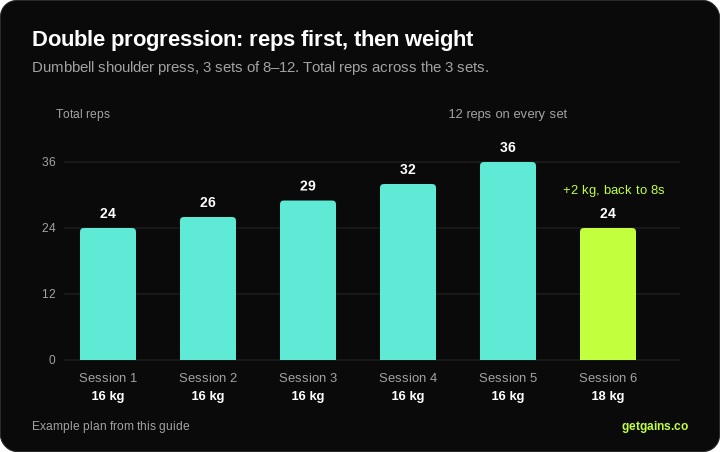
Here’s what that looks like on a dumbbell shoulder press:
| Session | Weight | Set 1 | Set 2 | Set 3 |
|---|---|---|---|---|
| 1 | 16 kg (35 lb) | 8 | 8 | 8 |
| 2 | 16 kg | 9 | 9 | 8 |
| 3 | 16 kg | 10 | 10 | 9 |
| 4 | 16 kg | 11 | 11 | 10 |
| 5 | 16 kg | 12 | 12 | 12 |
| 6 | 18 kg (40 lb) | 8 | 8 | 8 |
The ACSM gives a similar rule for heavier work: add 2–10% to the load once you can do one to two reps more than your target. On a 100 kg (220 lb) squat, that’s a jump of 2–10 kg (4–22 lb); smaller is usually smarter. It’s the same logic as a pay rise: a sensible bump you can live with beats a big one that falls apart a month later.
How fast should you progress?
Beginners can often add weight or reps almost every session for the first few months. As you get more experienced, progress slows down: the ACSM and Kraemer and Ratamess’s review both describe how trained lifters need more varied programming to keep improving.
A rough guide:
- First 3–6 months: add reps or weight most sessions on the main lifts.
- After that: progress week to week, or across a few weeks, rather than session to session.
- Experienced: progress is measured in months, and a good week can just be matching last week’s numbers with better form.
It’s like learning a language: the first hundred words come quickly, and fluency takes years.
Use effort (RPE) to progress without guessing
RPE (rating of perceived exertion) is a 1–10 score for how hard a set felt. In the version most lifters use, from Helms et al. (2016), it’s tied to how many reps you had left:
| RPE | Reps in reserve |
|---|---|
| 10 | 0 (couldn’t do another) |
| 9 | 1 |
| 8 | 2 |
| 7 | 3 |
If last week’s 3 × 8 at 60 kg felt like RPE 7 and this week it feels like RPE 6, that’s progress even though the numbers didn’t change, and it’s a sign you’re ready to add weight. If sets that used to be RPE 8 start creeping to 9 or 10, you’re due an easier week. Our RPE scale chart has the full scale.
When progressive overload stalls
Every lifter stalls. A stall usually means one of four things:
- Recovery: short sleep, a stressful week or too little food. You can’t build a house with the bricks still on the lorry.
- Too big a jump: go back to the previous weight and add reps instead.
- Too much volume: fewer, better sets can restart progress.
- Not enough protein: check your target with the protein calculator.
If a lift stalls for two or three weeks, change one thing at a time rather than everything at once, so you know what worked. If you’re also run down, try a deload week.
Track it, or it didn’t happen
Progressive overload only works if you know what you did last time. Trying to remember last Tuesday’s reps from memory is like trying to remember last month’s bank balance.
The Get Gains app does the remembering for you:
- Your Previous Best, pre-filled: when you add an exercise, its first set is filled in with your previous best weight and reps and labelled “Previous Best”, so you know the number to beat before you lift.
- PBs flagged as you lift: beat a previous best at any rep count and Get Gains flags the PB straight away, so rep PBs count as well as weight PBs.
- RPE on each set: log how hard it felt, so you can see effort drop as you get stronger.
- Warm-up sets kept separate: mark a set as a warm-up and it’s left out of your PBs and volume, so your progress charts show working sets only.
- Charts and estimated 1RM: see each lift trend upward over weeks and months. Our 1RM calculator uses the same idea.
- Plate calculator: work out what to load on each side of the bar for the new weight, using the plates your gym has. There’s a web version too.
Progressive overload: quick answers
- What is it? Gradually making training harder: more weight, reps, sets or effort, or better technique.
- Do I have to add weight every week? No. Adding reps works as well as adding weight for muscle growth, according to Plotkin et al. (2022).
- How much weight should I add? The smallest jump available. The ACSM suggests 2–10% once you beat your target reps by one or two.
- What’s double progression? Add reps until you hit the top of your range on every set, then add weight and start again at the bottom.
How we wrote this: drafted with AI assistance, then fact-checked against the sources below and edited by Alex Lawrence. Read our editorial policy.
Sources
- American College of Sports Medicine (2009). Position stand: progression models in resistance training for healthy adults. Med Sci Sports Exerc 41(3):687-708
- Kraemer WJ, Ratamess NA (2004). Fundamentals of resistance training: progression and exercise prescription. Med Sci Sports Exerc 36(4):674-688
- Plotkin D et al. (2022). Progressive overload without progressing load? The effects of load or repetition progression on muscular adaptations. PeerJ 10:e14142
- Schoenfeld BJ, Ogborn D, Krieger JW (2017). Dose-response relationship between weekly resistance training volume and increases in muscle mass: a systematic review and meta-analysis. J Sports Sci 35(11):1073-1082
- Helms ER et al. (2016). Application of the repetitions in reserve-based rating of perceived exertion scale for resistance training. Strength Cond J 38(4):42-49