RPE Scale Chart for Lifting: What It Means and How to Use It
RPE stands for rating of perceived exertion. In lifting, it’s a score out of 10 for how hard a set was, based on how many more reps you could have done: RPE 10 means none, RPE 9 means 1, RPE 8 means 2 and RPE 7 means 3. Most working sets belong around RPE 7 to 9.
Here’s the full chart, what to aim for, how to use it to pick your weights, and how to get better at judging it.
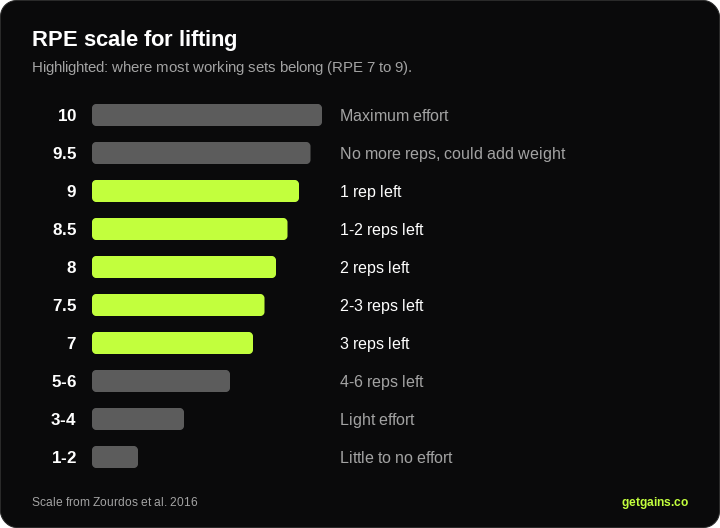
RPE scale chart for lifting
Each RPE score tells you roughly how many reps you had left when you stopped. This version, based on reps in reserve, was published for lifters in 2016, and it’s the one most gym programmes mean when they say “RPE”.
| RPE | Reps left | What it means |
|---|---|---|
| 10 | 0 | Maximum effort |
| 9.5 | 0 | No more reps, but slightly more weight was possible |
| 9 | 1 | One more rep was there |
| 8.5 | 1-2 | Definitely 1, maybe 2 |
| 8 | 2 | Two more reps were there |
| 7.5 | 2-3 | Definitely 2, maybe 3 |
| 7 | 3 | Three more reps were there |
| 5-6 | 4-6 | Moderate effort |
| 3-4 | Not scored in reps | Light effort |
| 1-2 | Not scored in reps | Little to no effort |
Think of it as the fuel gauge for a set. You aren’t measuring the engine, you’re just reading how much is left in the tank when you pull over.
What does RPE mean in the gym?
RPE is your own rating of how hard a set was, scored straight after you finish it. “3 x 8 at RPE 8” means three sets of eight with a weight that leaves about two reps in the tank each time.
You’ll also see RIR, or reps in reserve. It’s the same idea counted from the other end: RPE 8 is 2 RIR, and RPE 9 is 1 RIR. For most sets, RPE plus RIR adds up to 10.
The older general effort scales can be awkward for weights. Lifters have given scores of only 6.8 to 9.0 on those scales even after going to failure, which is why the reps-left version caught on.
What RPE should you train at?
For most lifters, RPE 7 to 9 is a sensible range for working sets, with beginners starting a little lower. These are practical starting points rather than tested rules:
| Type of set | Target RPE | Reps left |
|---|---|---|
| Warm-ups | Under 5 | Plenty |
| Learning a lift | 6-7 | 3-4 |
| Building muscle | 7-9 | 1-3 |
| Building strength | 6-8 | 2-4 |
| Deload week | 6 or lower | 4 or more |
| Last set of curls or raises | 9-10 | 0-1 |
The research explains why you don’t need to live at RPE 10. A 2023 review found no evidence that training to full failure beats stopping short for muscle growth. A 2024 analysis suggested muscle growth improves as sets get closer to failure, while strength gains were similar across a wide range. Its authors called the work exploratory, so don’t treat it as an exact formula.
Put together, hard sets count, but you don’t need to wring out every last rep. It’s like leaving for the train with a few minutes spare: you still get there, without sprinting down the platform every morning.
Save the very high scores for exercises where failure is safe, like machines, curls and lateral raises. On barbell squats and bench press, stop earlier unless you have spotters or safety bars set up.
How to use RPE to choose your weights
Pick a rep target and an RPE range, then adjust the weight based on how your sets feel. Say your plan is 3 x 8 at RPE 7 to 8, and you start with 60 kg:
| After your first set | RPE | Next step |
|---|---|---|
| You could have done 5 more | About 5 | Add weight |
| You could have done 2 or 3 more | 7-8 | Keep the weight |
| You had 1 more at most | 9 | Drop the weight a little |
| You barely got the eighth rep | 10 | Drop the weight more |
For a guide to how much, one trial used a target of RPE 6 to 8. Lifters changed the weight by about 4% per RPE point outside that range: up 4% after RPE 5, down 4% after RPE 9, and down 8% after RPE 10. On 60 kg, 4% is about 2.5 kg, which is handy because that’s often the smallest jump a gym allows.
Expect the score to creep up across your sets, because fatigue builds even when the weight stays the same. That’s normal. If a set goes past your range, take a little off rather than grinding on.
RPE also shows progress that the weight alone can miss. If 60 kg for 8 was RPE 8 last month and it’s RPE 6 now, you’ve got stronger, and it’s time to add some load.
Is RPE better than percentages?
They both work, and RPE has one big practical advantage: it adjusts to the day you’re actually having. In an 8-week trial of 21 trained men, strength rose in both the RPE and percentage groups. Squat 1RM went up about 17 kg with RPE and 14 kg with percentages, and bench about 11 kg and 10 kg. The differences weren’t statistically significant, though the authors noted RPE may give a small strength edge. Muscle size changes were similar.
A percentage of your one-rep max is a printed bus timetable. RPE is the live app that knows there’s traffic. After a bad night’s sleep, the same 80 kg can feel very different, and RPE lets you allow for that.
You can also combine them: start from a sensible percentage, then use RPE to fine-tune the weight.
How accurate is RPE?
Pretty good when you’re close to failure, and less reliable when you’re far from it. A review of 12 studies and 414 people found lifters underestimated their remaining reps by about 1 on average, with a lot of variation between studies.
The same review found guesses were better:
- closer to failure
- on sets of 12 reps or fewer
- slightly better in later sets
Fuel gauges work the same way. Near empty, you’ve got a fair idea how far you can go. On a full tank, “about 300 miles, probably” is the best anyone can do.
Trained lifters can get close. In one bench press study of 24 trained men and women, guesses of 1 and 3 reps left were off by about 0.65 reps on average. But practice alone may not fix everything: 9 trained men who rated their bench sets for 6 weeks didn’t get significantly more accurate.
Experience is a mixed picture too. Beginners in the original study rated a true one-rep max at only about 9, while experienced squatters scored it about 9.8. The 2022 review, on the other hand, didn’t find that training background changed accuracy much.
How to get better at judging RPE
Test yourself now and then on an exercise where failing is safe. A machine or dumbbell curl works well. Don’t do this on barbell squats or bench press without spotters or safety bars.
- Pick a moderate weight you can lift for about 8 to 12 reps.
- Note the rep when you think you have 2 left. Say it out loud or tell your training partner, without stopping the set.
- Carry on with good form until you can’t complete another rep.
- Compare the numbers. If you “had 2 left” and did 5 more, your RPE was really about 5.
- Write it down, so you can see whether you tend to guess low.
On average, people have about a rep more in them than they think. The first time you try this, the set you called “nearly dead” may turn out to have some life left in it.
If you’re new to lifting, use RPE as a note alongside your sets, not as the thing that decides your weights. That’s what the scale’s authors suggest too. Focus on learning the movements and adding weight steadily through a simple beginner plan.
RPE measures effort, not pain. Sharp pain, joint pain that’s getting worse, dizziness or chest pain means stop the set. Speak to your GP or a physio, and if you have a heart condition or high blood pressure, check with your GP before lifting close to your limit.
Common questions
What does RPE stand for?
Rating of perceived exertion. In the gym, it usually means the 1 to 10 scale based on how many reps you had left.
What does RPE 8 mean?
You finished the set feeling you could have done about 2 more good reps.
Is RPE 10 the same as failure?
Near enough. RPE 10 means maximum effort, with no more reps possible and no extra weight possible either.
What’s the difference between RPE and RIR?
RIR counts the reps you had left, and RPE turns that into a score out of 10. RPE 7 is the same as 3 RIR.
Should beginners use RPE?
Yes, but lightly. Log it to learn what hard sets feel like, and stay around RPE 6 to 7 while you learn each lift.
Is RPE the same for cardio?
Not quite. Cardio RPE scales rate your overall effort and breathing, because there are no reps left to count. The scale on this page is for lifting.
Track your RPE with Get Gains
A score only helps if you can look back at it, and “I think it felt alright last month” isn’t much of a training record. Get Gains keeps it with the rest of your set:
- RPE on every strength set: there’s a box next to weight and reps. It’s optional, so you can fill it in only for the sets you care about.
- See it later: your finished sessions show the RPE beside each set, so you can compare how the same weight felt over time.
- Keep the context: weight, reps and effort sit together, which makes it easier to spot a lift getting easier or a deload coming due.
Prefer a spreadsheet? Our workout tracker template does the logging there instead.
How we wrote this: drafted with AI assistance, then fact-checked against the sources below and edited by Alex Lawrence. Read our editorial policy.
Sources
- Zourdos MC et al. (2016). Novel resistance training-specific rating of perceived exertion scale measuring repetitions in reserve. J Strength Cond Res 30(1):267-275. PMID 26049792
- Helms ER, Cronin J, Storey A, Zourdos MC (2016). Application of the repetitions in reserve-based rating of perceived exertion scale for resistance training. Strength Cond J 38(4):42-49. PMID 27531969
- Helms ER et al. (2018). RPE vs. percentage 1RM loading in periodized programs matched for sets and repetitions. Front Physiol 9:247. PMID 29628895
- Halperin I et al. (2022). Accuracy in predicting repetitions to task failure in resistance exercise: a scoping review and exploratory meta-analysis. Sports Med 52(2):377-390. PMID 34542869
- Refalo MC et al. (2024). Accuracy of intraset repetitions-in-reserve predictions during the bench press exercise in resistance-trained male and female subjects. J Strength Cond Res 38(3):e78-e85. PMID 37967832
- Remmert JF et al. (2023). Changes in intraset repetitions in reserve prediction accuracy during six weeks of bench press training in trained men. Percept Mot Skills. PMID 37436724
- Refalo MC, Helms ER, Trexler ET, Hamilton DL, Fyfe JJ (2023). Influence of resistance training proximity-to-failure on skeletal muscle hypertrophy: a systematic review with meta-analysis. Sports Med 53(3):649-665. PMID 36334240
- Robinson ZP et al. (2024). Exploring the dose-response relationship between estimated resistance training proximity to failure, strength gain, and muscle hypertrophy: a series of meta-regressions. Sports Med 54(9):2209-2231. PMID 38970765