Deload Week: What It Is, When to Take One and How
A deload week is a planned week of easier training that lets fatigue drop before you push on again. The simplest version: keep your usual exercises and training days, halve your sets, and stop every set well short of failure. Lifters commonly take one every 4 to 6 weeks or when progress stalls, but there’s no proven schedule, and you may not need one that often.
Here’s what a deload actually does, how to tell when you need one, exactly how to run the week, and whether you’d be better off just taking the week off.
What does deload mean in the gym?
A deload is a short, deliberate drop in how hard you train. A 2023 panel of expert coaches defined it as a period of reduced training stress meant to ease physical and mental fatigue, help you recover and leave you ready for the next block.
Think of it as charging your phone before it hits 1%. You’re not throwing the phone away, and you’re not buying a new one. You’re just making sure it still works for the rest of the day.
The key word is planned. A deload is different from missing a week because work went sideways, even if the two can feel similar by Friday.
Do you actually need a deload?
Probably not as a strict rule. Deloads are a sensible way to manage fatigue, but the research so far hasn’t shown that they build more muscle or strength on their own.
There are only a few direct trials, and they’re small:
- Fewer sets and sessions, untrained men: 19 beginners cut to one session a week and 2 sets per exercise in weeks 4 and 8 of an 8-week programme. Muscle growth and 10-rep strength matched continuous training.
- A full week off, trained lifters: 39 men and women stopped lifting for one week halfway through 9 weeks. Lower-body muscle growth, endurance and power were similar, but the group that kept training gained more lower-body strength.
So an easier week doesn’t seem to cost you muscle. It also isn’t a secret growth trick. It’s more like a service on your car: it won’t add horsepower, but it can stop small problems turning into a breakdown on the M6.
That’s why so many experienced lifters still use them. In a survey of 246 competitive strength and physique athletes, all of them deloaded, mainly to manage energy and fatigue. That tells you it’s popular and feels useful, not that it’s been proven to work better.
When should you take a deload week?
Take one when fatigue is piling up and your training is suffering, or plan one in every 4 to 6 weeks if you like a set routine. Both approaches are common.
The athletes in that survey typically deloaded when performance stalled, or when muscle soreness or joint aches went up. Watch for:
- the same lifts stalling or going backwards for 2 to 3 sessions
- joints that ache, rather than muscles that are just tired
- soreness that’s still there at your next session
- dreading workouts you normally enjoy
- poor sleep or a stressful spell making everything feel heavier
Here’s how the two approaches compare:
| Approach | How it works | Suits |
|---|---|---|
| Planned | Book one in every 4 to 6 weeks | High-volume programmes, and people who won’t back off unless it’s on the calendar |
| When you need it | Deload when two or more of the signs above show up | Beginners, moderate programmes, and people who read their training well |
How often do people really do it? Coaches interviewed in one study usually programmed 5 to 7 days every 4 to 6 weeks, though it varied a lot. Athletes averaged about 6 days, roughly every 5 to 6 weeks. Treat those as what people do, not as a tested prescription.
If you’re in your first year of lifting and still adding weight most weeks, you can usually skip the schedule. Short of the warning signs above, keep progressing as normal.
How to deload: the simple method
Keep your exercises and training days the same, cut your sets roughly in half, and finish every set feeling you had plenty left. That matches what lifters report doing: less volume, less effort, often less weight, same training frequency and mostly the same exercises.
No study has pinned down the best numbers, so these are sensible starting points. Here’s how they look if you normally squat 100 kg for 4 sets of 8:
| Deload type | Weight | Sets x reps | Good when |
|---|---|---|---|
| Your normal week | 100 kg | 4 x 8 | For comparison |
| Fewer sets (start here) | 100 kg | 2 x 6 | You’re tired but your joints feel fine |
| Lighter weight | 85 kg | 3 x 8 | Joints are achy and heavy loads feel rough |
| Both | 85 kg | 2 x 6 | You’re properly run down |
Whichever you pick:
- Stay well away from failure. Finish each set feeling you could do at least 4 more reps, which is about RPE 6 or lower.
- Keep the movements. Same exercises, so the patterns stay familiar and next week doesn’t feel like starting a new job.
- Skip the extras. No drop sets, no max attempts, no chasing PBs. This is the one week a new record is a bad sign.
- Keep eating and sleeping well. Stay on your normal protein and don’t treat the week as a reason to crash diet.
- Leave sooner rather than later. Sessions should feel short and a bit too easy. If you leave thinking “was that it?”, you’ve done it right.
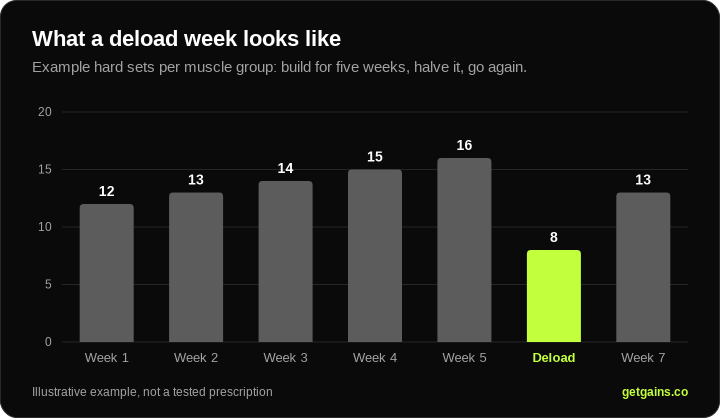
If you’re counting your weekly sets per muscle group, a muscle getting 16 hard sets drops to about 8 for the week.
A deload won’t fix an injury. If you have sharp pain, swelling, or pain that doesn’t settle with rest, stop training that area and speak to your GP or a physio.
Deload vs a week off
A lighter week is the safer default, especially if strength matters to you, but a full week off won’t undo your progress. If life has taken the week away from you anyway, don’t stress about it.
| Lighter week | Full week off | |
|---|---|---|
| Habit | Keeps going | Paused |
| Muscle growth | Held up in a small trial of untrained men | Held up in a trial of trained lifters |
| Strength | 1-rep strength not tested | Smaller lower-body gains in that trial |
| Best for | Most planned deloads | Holidays, illness, busy weeks |
The longer-term data is reassuring too. Trained men kept their leg press strength after 2 weeks off. And in a 24-week bench press study of young men, taking 3 weeks off after every 6 weeks of training ended with similar muscle and strength gains to training straight through.
Your muscle isn’t milk. It doesn’t go off because you left it for a week.
What to do after a deload
Go back to your normal sets and the weights you were using before, then build from there. Don’t test a new max on day one. Give yourself a session or two to get back into the groove, and if the deload did its job, training should feel better than it did before you backed off.
If you feel no better at all after an easier week, the problem may sit outside the gym. Check your sleep, your stress and whether you’re eating enough, and consider whether your programme has too much volume.
Common questions
How long should a deload last?
About a week is standard. Coaches and athletes in the research mostly use 5 to 7 days.
How often should you deload?
Commonly every 4 to 6 weeks, but it varies, and there’s no proven best schedule. Many people do fine deloading only when fatigue builds or lifts stall.
Will I lose muscle on a deload week?
It’s very unlikely. In the trials above, muscle growth was similar with a deload, including a full week off lifting.
Should beginners deload?
Usually not on a schedule. Beginners tend to lift less total weight and can often keep progressing for months. Take an easier week if you feel run down or your joints are complaining.
Can I still do cardio on a deload?
Yes, keep it easy. Walking or a gentle bike ride is fine. A deload where you swap lifting for hard intervals isn’t much of a deload.
Is a deload the same as a taper?
Not quite. A taper cuts training before a competition so you peak on the day. A deload is a routine reset in the middle of normal training, with no big performance to peak for.
Plan your deload with Get Gains
Knowing when you need a deload is much easier when your training is written down, rather than stored in the same brain that’s currently telling you everything feels heavy. Get Gains helps with that:
- Spot the stall: log your sets, reps, weight and RPE, and your history shows when a lift has stopped moving.
- Check your volume: the weekly progress report counts your working sets per muscle group next to last week’s, so you can see the deload drop and the return.
- Flag it: the optional check-in when you finish a workout includes a “Want a deload” tag, saved with that session.
- Ask the coach (Titan): Gains Coach sees your recent training, so you can ask whether a deload makes sense right now. You still make the changes to your sessions yourself.
Prefer a spreadsheet? Our workout tracker template does the logging in a spreadsheet.
How we wrote this: drafted with AI assistance, then fact-checked against the sources below and edited by Alex Lawrence. Read our editorial policy.
Sources
- Bell L, Strafford BW, Coleman M, Androulakis Korakakis P, Nolan D (2023). Integrating deloading into strength and physique sports training programmes: an international Delphi consensus approach. Sports Med Open 9(1):87. PMID 37730925
- Bell L et al. (2022). "You can't shoot another bullet until you've reloaded the gun": coaches' perceptions, practices and experiences of deloading in strength and physique sports. Front Sports Act Living 4:1073223. PMID 36619355
- Rogerson D et al. (2024). Deloading practices in strength and physique sports: a cross-sectional survey. Sports Med Open 10(1):26. PMID 38499934
- Coleman M et al. (2024). Gaining more from doing less? The effects of a one-week deload period during supervised resistance training on muscular adaptations. PeerJ 12:e16777. PMID 38274324
- Pancar Z et al. (2026). Effects of deload periods in resistance training on muscle hypertrophy and strength endurance in untrained young men using a randomized within subject design. Sci Rep 16(1):10299. PMID 41730991
- Hwang PS et al. (2017). Resistance training-induced elevations in muscular strength in trained men are maintained after 2 weeks of detraining and not differentially affected by whey protein supplementation. J Strength Cond Res 31(4):869-881. PMID 28328712
- Ogasawara R, Yasuda T, Ishii N, Abe T (2013). Comparison of muscle hypertrophy following 6-month of continuous and periodic strength training. Eur J Appl Physiol 113(4):975-985. PMID 23053130
- Travis SK, Mujika I, Gentles JA, Stone MH, Bazyler CD (2020). Tapering and peaking maximal strength for powerlifting performance: a review. Sports 8(9):125. PMID 32917000