How Many Sets per Muscle Group per Week? (By Level)
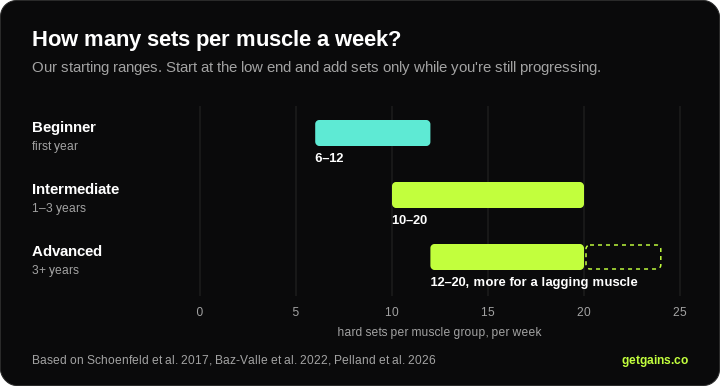
For most people training to build muscle, 10–20 hard sets per muscle group per week is a sensible target. Beginners grow well on less, around 6–12. Spread those sets over at least two sessions, so a typical workout has about 4–10 sets per muscle you’re training that day.
Training volume is a bit like watering a plant. Too little and nothing much happens; more helps, up to a point; and past that point you’re just making mud. The research below shows where most people’s “enough” sits, and how to find your own.
Weekly sets per muscle group: the short answer
These are our starting ranges, built from the research below. Start at the low end and only add sets while you’re still progressing.
| Experience | Hard sets per muscle per week | What it looks like |
|---|---|---|
| Beginner (first year) | 6–12 | 2–3 full-body sessions, 2–3 sets of 1–2 exercises per muscle |
| Intermediate (1–3 years) | 10–20 | An upper/lower split or push pull legs, each muscle trained twice a week |
| Advanced (3+ years) | 12–20, sometimes more | The same, with extra sets for one lagging muscle at a time |
What the research says about sets per week
Three reviews do most of the heavy lifting here.
- More sets, more growth, up to a point. A 2017 meta-analysis by Schoenfeld and colleagues pooled 15 studies and found a graded dose-response: each extra weekly set was linked to a slightly bigger gain in muscle size (about 0.37% per set), and higher-volume groups beat lower-volume ones.
- 12–20 sets as a standard recommendation. A 2022 systematic review by Baz-Valle and colleagues, in young men with at least a year of training, suggested 12–20 weekly sets per muscle group “may be an optimum standard recommendation”. More than 20 sets didn’t beat 12–20 for the quads or biceps; it did for the triceps.
- Diminishing returns. The biggest analysis so far, Pelland and colleagues (2026), covered 67 studies and 2,058 people. Muscle size and strength both kept rising as weekly sets went up, but with diminishing returns, and the returns tailed off much faster for strength than for size.
So “more is better” is true, but each extra set buys a little less than the one before. It’s like adding sugar to tea: the first spoon changes everything, the fifth mostly changes your dentist’s mood.
How to count your sets
Not every set counts the same. Three simple rules:
- Only count hard sets. A set counts if it ends reasonably close to failure: roughly 1–4 reps left in the tank, an RPE of about 6 or higher. Warm-ups don’t count.
- Count direct sets in full. A set of curls is one set for your biceps.
- Count indirect sets as half. A bench press mainly trains your chest, but it works your triceps and front shoulders too. Pelland and colleagues found counting those indirect sets as half a set predicted results best.
| Exercise (1 hard set) | Counts as |
|---|---|
| Bench press | 1 chest, ½ triceps, ½ front shoulders |
| Lat pulldown or row | 1 back, ½ biceps |
| Squat | 1 quads, ½ glutes |
| Romanian deadlift | 1 hamstrings, ½ glutes |
| Biceps curl | 1 biceps |
This is why you may not need many direct arm sets: if you press and pull a lot, your arms are already getting half-credit all week.
How many sets per workout?
Divide your weekly target by how many times you train that muscle. Twice a week is a good default; the ACSM’s position stand suggests 2–3 training days a week for beginners and 3–4 for intermediates.
| Weekly target | Trained 2× a week | Trained 3× a week |
|---|---|---|
| 8 sets | 4 per session | 2–3 per session |
| 12 sets | 6 per session | 4 per session |
| 16 sets | 8 per session | 5–6 per session |
| 20 sets | 10 per session | 6–7 per session |
Splitting the work matters because a single session can only do so much. Twenty sets of chest on a Monday is the training equivalent of eating a week’s vegetables in one sitting. For size, Pelland and colleagues found frequency mattered little once weekly sets were the same, so pick whatever split you’ll actually stick to. For strength, training a lift more often did help.
How many sets per exercise? Usually 2–4 hard sets. Beyond that, a second exercise for the same muscle tends to be fresher and more useful than a fifth set of the first.
How many sets for strength vs size?
- For muscle size: the ranges above. Volume is the main lever.
- For strength: you need fewer sets than you’d think, because returns tail off quickly. Heavier sets of fewer reps, and practising the lift more often, matter more. Our 1RM calculator helps you pick training weights.
Signs you’re doing too many (or too few) sets
| Too few | Too many |
|---|---|
| You’re not sore or tired at all, ever | Soreness from one session is still there at the next |
| Lifts and reps have stalled for weeks, and recovery feels easy | Weights are going down, not up |
| Sessions are over in 25 minutes | Joints ache and sleep gets worse |
If you’re stalled and recovering well, add 1–2 sets per muscle per week and give it 3–4 weeks. If you’re stalled and run down, take sets away, or take an easier week (a deload). Change one thing at a time so you know what worked.
See your weekly sets per muscle in Get Gains
Counting sets in your head across a whole week is like trying to keep a running total of your shopping without a receipt. The Get Gains app keeps the receipt:
- Volume by muscle group: the weekly progress report counts your working sets for each muscle group and shows them next to last week’s, so you can see if your chest got 14 sets and your back only 6.
- Imbalance warnings: if a muscle group gets less than half the sets of your most-trained one, the report flags it.
- Warm-ups left out: mark a set as a warm-up and it doesn’t count towards your volume or PBs.
- Muscle map: a heatmap of which muscles you’ve trained over the last 30 days.
The app counts each set once, against the exercise’s main muscle group, so it’s a quick check rather than the half-set maths above. Prefer a spreadsheet? Our free workout tracker template logs every set too.
Sets per muscle group: quick answers
- How many sets per muscle group per week? 10–20 hard sets for most people building muscle; around 6–12 if you’re a beginner.
- Is 10 sets per week enough? For most beginners and many intermediates, yes. Add more only when progress stalls and you’re recovering well.
- Is more than 20 sets a week better? Sometimes, for a single muscle and a few weeks. The returns get smaller with every set, and recovery gets harder.
- Do warm-up sets count? No. Count only hard working sets.
- How many sets per workout? Your weekly target divided by how many times you train each muscle: often 4–10 sets per muscle per session.
How we wrote this: drafted with AI assistance, then fact-checked against the sources below and edited by Alex Lawrence. Read our editorial policy.
Sources
- Schoenfeld BJ, Ogborn D, Krieger JW (2017). Dose-response relationship between weekly resistance training volume and increases in muscle mass: a systematic review and meta-analysis. J Sports Sci 35(11):1073-1082
- Baz-Valle E, Balsalobre-Fernández C, Alix-Fages C, Santos-Concejero J (2022). A systematic review of the effects of different resistance training volumes on muscle hypertrophy. J Hum Kinet 81:199-210
- Pelland JC, Remmert JF, Robinson ZP, Hinson SR, Zourdos MC (2026). The resistance training dose response: meta-regressions exploring the effects of weekly volume and frequency on muscle hypertrophy and strength gains. Sports Med 56(2):481-505
- American College of Sports Medicine (2009). Position stand: progression models in resistance training for healthy adults. Med Sci Sports Exerc 41(3):687-708